Dispatches from the End of Ice by Beth Peterson
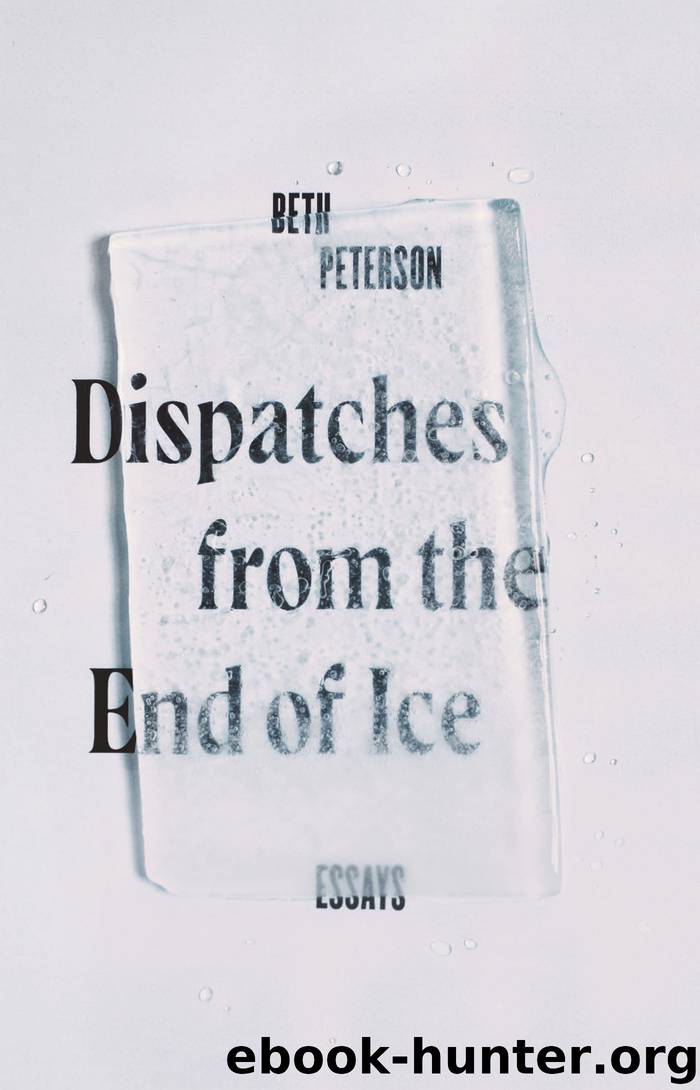
Author:Beth Peterson
Language: eng
Format: epub
Publisher: Trinity University Press
Published: 2019-12-11T16:00:00+00:00
The study of ice began in earnest almost 175 years ago, though it’s possible individual scientists studied and collected ice much before that. In his “History of Early Polar Ice Cores,” Chester C. Langway Jr. notes that as early as the 1840s and up until the 1940s scientists dug deep pits in glaciers, trying to discover their thickness. Some researchers cut through the ice manually; others used chainsaws to dig these holes, holes big enough for the scientists to climb inside. One of these early ice researchers, Ernst Sorge, lived in a snow cave underground for seven months next to his fifteen-meter-deep pit of ice. In a biography of Sorge, I read that a group of men, convinced that he might run out of food, once hiked all the way to Sorge’s snow cave and pit with food and a series of winter supplies. As the story goes, the snow was so deep that only two men actually made it to Sorge’s site, and on the way back, neither of those men made it back alive.
Ice studies gradually moved away from hand-dug pits and toward cutting long samples, or cores, straight from the ice. In the late 1940s and early 1950s three separate excursions set out to recover and study one-hundred-meter deep ice cores: a Norwegian-British-Swedish team on Queen Maud Land, the French Polar Expedition in Greenland, and the Juneau Ice Field Research Project in Alaska. Along with collecting polar ice cores, these expeditions began to study measurements like grain size, density, and air bubbles.
According to many scientists, though, it was in 1957 that modern ice research emerged when the U.S. Army Corps of Engineers began to extract even deeper ice cores, four hundred meters deep. When they were taken out of the ice, ice cores were then shipped to “cold rooms,” placed in long metal canisters, labeled, and stored on rows of metal shelving. In black-and-white photographs from the early days of storage, there are rooms full of those metal cannisters, the ends penned with details about the ice. Scientists in those photos attend to the ice in parkas and snow pants.
Scientists had declared 1957—the year glacial drilling took off—the International Geophysical Year. Following the example of earlier international polar years, sixty-seven countries worked on scientific ventures. Along with the glacial study, Sputnik 1 was launched that year, then Sputnik 2, Explorer 1, and Vanguard 1 all spun into space.
Download
This site does not store any files on its server. We only index and link to content provided by other sites. Please contact the content providers to delete copyright contents if any and email us, we'll remove relevant links or contents immediately.
Still Foolin’ ’Em by Billy Crystal(36405)
We're Going to Need More Wine by Gabrielle Union(19108)
Plagued by Fire by Paul Hendrickson(17463)
Pimp by Iceberg Slim(14667)
Molly's Game by Molly Bloom(14195)
Becoming by Michelle Obama(10060)
When Breath Becomes Air by Paul Kalanithi(8508)
Educated by Tara Westover(8110)
The Girl Without a Voice by Casey Watson(7925)
The Incest Diary by Anonymous(7758)
Note to Self by Connor Franta(7701)
How to Be a Bawse: A Guide to Conquering Life by Lilly Singh(7547)
The Space Between by Michelle L. Teichman(6975)
What Does This Button Do? by Bruce Dickinson(6262)
Imperfect by Sanjay Manjrekar(5905)
Permanent Record by Edward Snowden(5892)
A Year in the Merde by Stephen Clarke(5471)
Shoe Dog by Phil Knight(5322)
Promise Me, Dad by Joe Biden(5190)
